
Marketing campaigns involve dozens of moving parts. From initial strategy to content creation and performance analysis, the process is filled with repetitive tasks that consume countless hours. Many teams turn to AI for help but find the results are generic and uninspired. The output sounds plausible but fails to connect with audiences or drive real action. This leads to a frustrating cycle of endless prompt tweaking and disappointing outcomes. Watch The Video
How to automate your entire campaign workflow using AI prompts the “right” way..
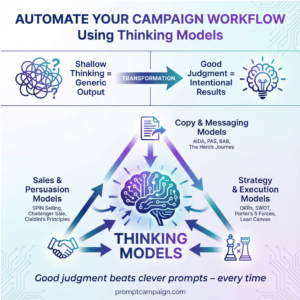
Here’s what most people get wrong: they think better AI output comes from more detailed or clever prompts.
It doesn’t.
The problem isn’t the prompt itself. The problem is the absence of strategic judgment behind the prompt. AI doesn’t need clearer instructions. It needs better thinking to guide it. When you provide an AI with a proven decision-making model before you ask it to write, you get intentional results instead of random variations. This is the foundation of a true prompt-driven campaign workflow.
This article presents a practical system to automate your entire campaign workflow using AI prompts. It moves beyond simple content generation and shows you how to embed expert-level judgment into every stage of your process. You’ll learn how to replace routine tasks with powerful AI systems so you can focus on high-level strategy and creative thinking, with AI handling the execution.
Mapping Your Campaign Workflow Into Prompt-Driven Stages
Effective AI campaign automation isn’t about finding a single magic prompt. It’s about building a system where each stage of your workflow is guided by a consistent strategic framework. Instead of asking the AI what to say, you first teach it how to think. This is achieved by using “Thinking Models” – repeatable methods of reasoning used by highly skilled operators to make their decisions.
By applying a specific Thinking Model at each stage, you make sure every piece of content (from a campaign brief to an ad variant) is aligned and intentional. The AI stops being a simple text generator and becomes a consistency engine that executes your strategic decisions at scale.
Here’s how Thinking Models transform each stage of a typical marketing campaign:
| Campaign Stage | Traditional AI Approach (Instructions) | Thinking Model Approach (Judgment) |
|---|---|---|
| Campaign Strategy | “Generate a campaign brief for a new product.” | Apply the USP Architect model to define the single meaningful difference and build the brief around that core message. |
| Content Creation | “Write five social media posts about our new feature.” | Use the Conversion Copywriter model to first identify reader anxiety and desired actions, then generate posts that reduce doubt. |
| Audience & Asset Alignment | “Create ad copy for three different audiences.” | Employ the Market Sophistication Strategist to adjust messaging based on how aware each audience segment is of the problem and solution. |
| Performance & Optimization | “Analyze the campaign data and suggest improvements.” | Use the Research-Driven Strategist model to have the AI identify which metrics matter most based on the initial goals and suggest tests based on evidence (not just correlations). |
Creating Core Prompts That Replace Strategy, Planning and Copy Tasks
When you lead with a Thinking Model, your prompts become simpler and more powerful. They’re no longer lengthy instructions filled with desperate attempts to add context. Instead, they become focused requests for the AI to apply the judgment you’ve already provided. These become your core AI prompts for marketing.
This approach helps you build a library of strategic assets – not just a folder of disconnected content. Below are examples of prompt types that emerge from a Thinking Model-driven workflow. Notice how they’re designed to execute a decision that has already been made:
Messaging Framework Prompt: After using the USP Architect model, you’d ask the AI to “Generate a complete messaging framework based on the core differentiator ‘[Your Unique Selling Proposition]’. Include a value proposition headline, key talking points and a list of phrases to avoid.”
Audience Anxiety Analysis Prompt: Guided by the Conversion Copywriter model, your prompt would be “For an audience of [Your Target Persona] who needs to make [Decision], list the top five anxieties that would stop them from acting. For each anxiety, suggest a message that would reduce that specific doubt.”
Angle and Hook Discovery Prompt: Using the Market Sophistication Strategist, you can ask “Our audience is [Awareness Level, e.g., ‘Problem-Aware but not Solution-Aware’]. Generate five unique angles for a blog post that will connect their known problem to our new solution without sounding like a direct sales pitch.”
Compliance and Clarity Check Prompts: A Common Sense Operator model would lead to prompts like “Review this ad copy for clarity and remove all marketing jargon. Rewrite any sentence that is longer than 20 words.”
Connecting Prompts: From Judgment to a Cohesive Workflow
AI prompt chaining is the concept of linking AI tasks together to create a full workflow. This idea only works when a single source of truth guides every step. A Thinking Model provides that source of truth. It’s the thread that connects your entire campaign, keeping everything consistent from the first strategic thought to the final ad click.
Without a unifying judgment framework, prompt chaining creates chaos. An AI might generate a brilliant email using one set of assumptions and then create a completely disconnected landing page using another. The result? A fractured customer experience that feels noisy and untrustworthy.
When you start with a Thinking Model, the workflow becomes seamless:
1. Choose Your Thinking Model: You decide upfront how decisions will be made. For instance, you might choose the Challenge-First Seller model for a B2B lead generation campaign.
2. Generate the Core Asset: You use an AI prompt to create the central piece of strategic material, such as a problem-focused webinar outline based on the chosen model.
3. Cascade to Downstream Assets: You then use subsequent prompts to have the AI create all other campaign assets based on that core document. For example: “Using the attached webinar outline, write a five-part email sequence to drive registrations” or “Create a LinkedIn post that highlights the core challenge discussed in slide 3 of the webinar outline.”
This method makes AI campaign automation a reality. Your workflow is no longer just a series of disconnected tasks but a cohesive system for executing a single strategic vision.
For those looking to explore advanced methods for creating deeply personalized and psychologically-driven marketing campaigns, you will find the Thinking Model Prompts tool to be a valuable resource.
The Future of AI in Marketing is Judgment!
To truly automate your entire campaign workflow using AI prompts, you must shift your focus from prompt wording to the thinking behind them. The most effective marketing teams won’t be the ones with the best prompt libraries. They’ll be the ones with the best judgment frameworks. By embedding the repeatable decision-making processes of expert operators into your AI systems, you create marketing that is not just efficient but also intentional, consistent and effective.
Start by identifying the Thinking Models that drive success in your industry. Apply them consistently at every stage of your workflow and watch as your AI-generated content transforms from generic noise into messaging that connects and converts.